
Suwanee, GA · Garage Door Service
When an Older Door in Suwanee Is Still Worth Fixing
Most Suwanee garage doors date to the 1980s-2000s building boom. Here's how to tell if yours is worth repairing or ready to retire, based on this area's housing stock.
- Repairs & new doors
- Springs & openers
- Serving 4 nearby communities
The Problem
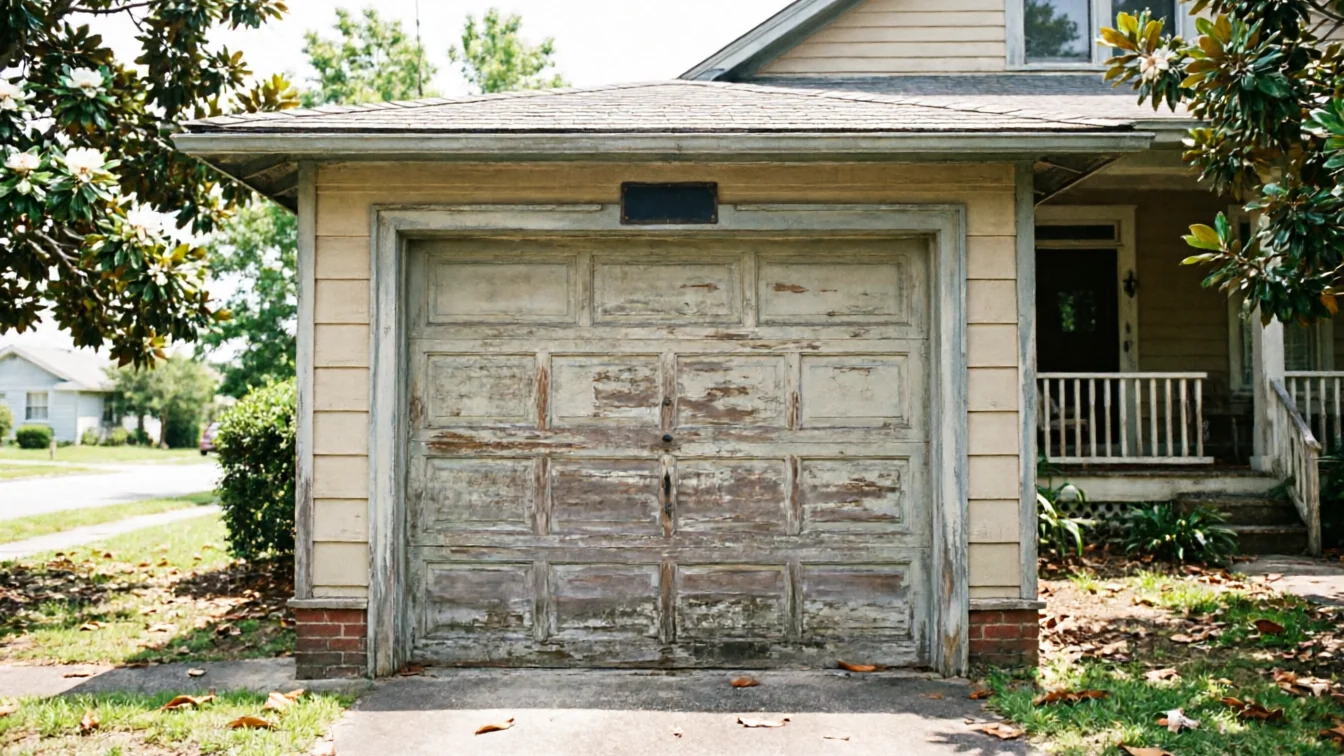
Suwanee's housing stock runs 1951 to 2012, with the median build year sitting at 1995, and across the fourteen named areas in this service territory most of it went up in the 1980s and 90s. That matters more than people think when a door starts acting up. A door installed in a 1988 build has had over three decades of cycles on its springs, rollers, and hinges, and the hardware specs from that era aren't always what a parts truck carries today. The question isn't "is my door broken," it's "is my door from an era where the parts still exist." Most of what we see is either late-80s steel sectional doors on their original torsion springs, or early-90s builds with the first generation of chain-drive openers. Both can usually be kept running. What can't always be kept running is a door with a bent track from an impact, or a bottom panel that's rusted through at the weld seam - common on the older end of that 1951-2012 range, less common on anything built after 2000.
When Waiting Is Fine
If the door is noisy but closes flush and seals at the bottom, you don't need a same-week call. A squeaky roller on a house from the 1980s-90s core of this area's stock is wear, not failure, and it'll usually hold for weeks before it gets worse. Same with a slow-closing opener that still finishes the job - that's often a limit switch or a sensor needing a wipe-down, not a reason to replace a unit. With median household income here at $78,695 across roughly 19,500 owner-occupied houses in the broader service area, a lot of owners have the option to fix now or fix in a month, and for cosmetic wear or minor noise, a month costs nothing. Waiting is a problem when the spring itself is visibly stretched or one coil is separated - that's not a maintenance item, that's a door that can drop. Everything else on the "it's annoying but it still works" list can sit on a list until it's convenient.
What to Check
Start with the year the house was built, since Suwanee's stock runs from 1951 through 2012 and the hardware generation tells you what you're dealing with before a tech ever shows up. Pull the garage door opener's date (often on a sticker inside the motor housing) and the spring's wind direction and wire gauge if you can see them. Next, check the bottom seal - on houses from the older end of that range, the original vinyl astragal is long past its life and lets in more than it should. Look at the track mounting brackets for rust at the bolt holes; that's a common failure point on doors from the 1980s-90s core of this market, simply from age. Last, listen for the specific sound: a rhythmic thump on every rotation usually means a flat spot on a roller, while a grinding on open or close more often points to the opener gear, not the door itself. None of this requires tools, just five minutes before you decide whether to call.
What the Weather Here Does to It
This area sits in a cold-moderate climate band, which means the door hardware goes through a real freeze-thaw cycle every winter, not a token one. Steel contracts in cold mornings and that's when a marginal spring or a loose track bolt shows itself - the door that worked fine in October suddenly binds in January. It's also why lubrication matters more here than in a warm-climate market: grease that's gone tacky from summer heat doesn't flow in the cold, and that's often what turns a quiet door into a grinding one by midwinter. None of this is dramatic weather - no hurricane damage, no hail dents to speak of in what we see - it's just steady seasonal cycling wearing on hardware that's often 15 to 30 years old given the housing stock here. A door built for this area's climate band, with a working bottom seal, holds up fine. One with a worn seal and sun-dried grease is the one that calls us in February.
Frequently asked questions
My house was built in the 90s - is the original garage door opener worth keeping?
Often yes. A lot of the 1980s-90s stock in this area still runs its original chain-drive opener, and those units are mechanically simple - usually a gear, a chain, and a motor. If the motor still turns and the gear isn't stripped, it's cheaper to replace the gear kit than the whole opener.
How do I know if my spring is original to the house?
If nobody's mentioned replacing it and the house dates to the 1980s or 90s core of this area's stock, there's a real chance it is. Original springs that old are a safety question, not a convenience one - a stretched coil or visible gap between coils means it's past due regardless of whether it's still technically working.
Is it ever cheaper to replace than repair an older door?
Sometimes, mainly when the panel section itself is rusted through or the track is bent beyond straightening. A spring, opener, or roller repair is almost always cheaper than a full door. We'll tell you straight if a fix doesn't make sense rather than patching something that'll fail again in a year.
Related garage door services in Suwanee
More garage door guides
Book garage door service in Suwanee
Call now or request a quote - tell us what the door is doing and where you are.