
Suwanee, GA · Garage Door Service
What Happens When a Spring Goes in Cold Weather Here
Most Suwanee garage doors date to the 1980s-90s boom, and cold snaps are when their original torsion springs finally let go. Here's what to check before you call.
- Repairs & new doors
- Springs & openers
- Serving 4 nearby communities
The Problem
Torsion springs lose a little tension every time the temperature drops, because cold steel is less elastic and the coil doesn't flex the way it does in July. A lot of houses in this service area were built between 1951 and 2012, with the median landing around 1995, and most of the stock across the fourteen named areas we work in went up in the 1980s and 90s. That means a huge share of the springs out there are original or close to it, sized for a door that's thirty-plus years old now. A spring rated for ten thousand cycles doesn't care what year it is, but cold adds stress right at the point where metal fatigue is already doing its work. You hear it as a bang from the garage, then the door won't move, or it moves and drops fast on one side. That's a broken torsion spring, not a motor problem, and running the opener anyway strains the drive gear and the cables next.
The honest part: once a spring snaps, there's no tightening or lubricating it back to life. It's a replacement, and on a two-spring setup we generally recommend doing both, since the second one is riding the same age and the same cold and is close behind.
When Waiting Is Fine
If the door still opens and closes, just a bit stiffer or noisier than usual, you don't need an emergency call. A spring under extra cold-weather tension can groan or feel heavier on the opener for a day or two without failing outright. If you can still get the car out and the door isn't sagging on one side, wait for daylight and call during normal hours - there's no safety reason to pay an after-hours rate for a door that still works.
Where waiting stops being fine: the door is stuck open with the garage exposed, or it's stuck closed over a car you need. Either way, treat it as a job for that day, not something to put off, since a door sitting open in a cold snap is a bigger problem than the spring itself.
What to Check
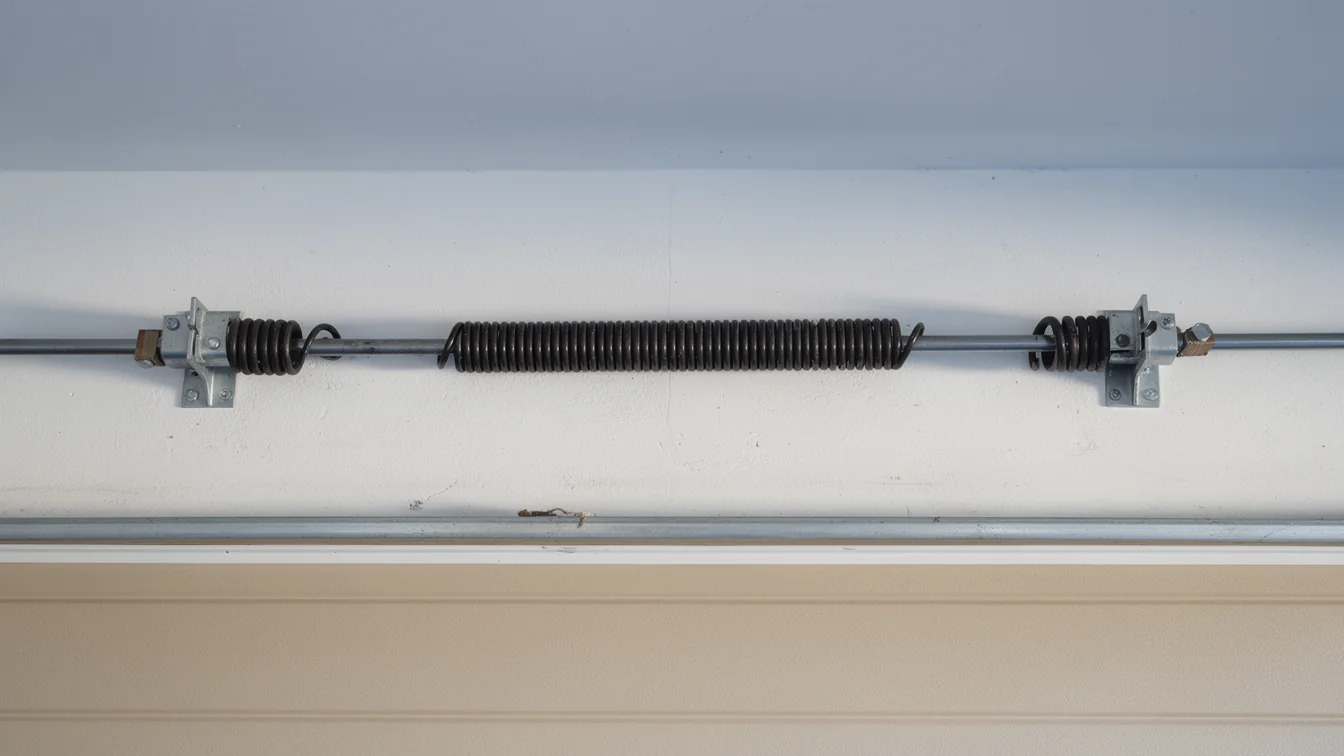
Look at the spring above the door, the long coil across the top. If it's split with a visible gap, that's your answer - don't operate the opener again until it's replaced. If the spring looks intact, check whether the door is level when it's halfway down; a door that tilts noticeably to one side usually means a cable has come off its drum, which often follows a spring failure.
Listen for the opener motor running without the door moving - that's a sign something broke and the opener doesn't know it yet. Don't try to pull the release cord and force the door by hand on a broken spring; a double door without its spring doing the lifting work can weigh well over a hundred pounds, and that's not a one-person lift, especially on wet concrete. If any of this matches what you're seeing, that's a call, not a DIY fix.
What the Weather Here Does to It
We're in a cold moderate climate band, which means winters here aren't brutal, but they're consistent enough to put real thermal cycling on steel hardware year after year - the freeze overnight, the thaw by afternoon, repeated for months. That cycling is harder on a spring than one hard freeze would be, because it's the repeated contraction and expansion that works the metal fatigue along faster than a mild climate would.
It also means the January and February cold snaps are genuinely the weeks we see the most spring failures, more than any other time of year. If your garage door was fine all fall and suddenly won't budge on a cold morning, that timing isn't a coincidence - it's the cold finishing off a spring that was already near the end of its cycle count. Across the area we cover - out past Berkeley Lake and Dacula, toward Cumming and Flowery Branch - the pattern holds the same way, because the housing ages and the winters land the same.
Frequently asked questions
Why does my garage door spring always seem to break in winter?
Cold steel flexes less, and repeated freeze-thaw cycling through a cold moderate winter fatigues a spring faster than steady weather would. If your spring was already near the end of its cycle life from age, a cold snap is often what finishes it off, which is why we see more of these calls in January and February than any other month.
Is it safe to open my garage door by hand if the spring breaks?
Not alone, and not without caution. Without the spring doing the lifting, a double door can weigh well over a hundred pounds unsupported. If you must get a car out, get help, go slow, and don't let the door drop. Otherwise, leave it closed and call - this isn't a repair to force.
My house is from the 1980s - should I expect spring trouble?
Possibly. A lot of the housing stock in this area dates to the 1980s and 90s, which means plenty of original torsion hardware is now thirty-plus years old. Age plus winter cycling is exactly the combination that leads to failure, so if your spring has never been replaced, it's worth having it looked at before it picks its own moment.
Related garage door services in Suwanee
More garage door guides
Book garage door service in Suwanee
Call now or request a quote - tell us what the door is doing and where you are.